

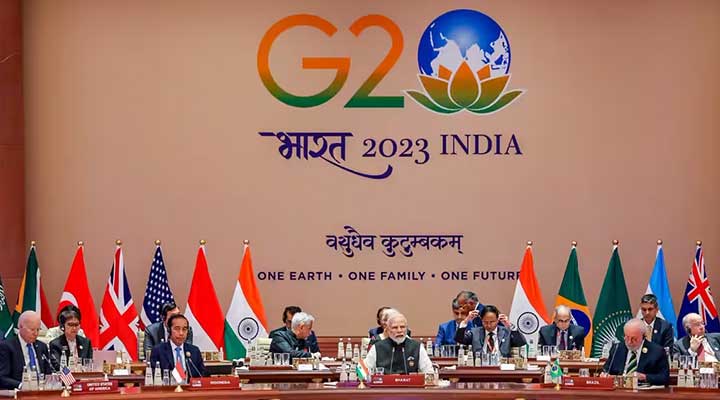
Delhi Declaration
G20 countries managed to compromise at the Delhi summit, overcoming their differences on the Ukraine situation and making a joint declaration that set the stage for addressing debt resolution and climate financing and focused on boosting development in the Global South.
Unlike last year's statement, the 83 paragraphs of the Delhi Declaration notably omitted explicit condemnation of Russia's actions in Ukraine, instead emphasizing the suffering and negative consequences of the Ukraine conflict, which complicated post-pandemic recovery efforts.
The revised language replaced "most members strongly condemned the war" with a commitment to uphold the United Nations Charter principles regarding territorial integrity and the use of force.
In a press conference after Indian Prime Minister Modi's joint declaration announcement, Foreign Minister Jaishankar recognized the significant effort invested in addressing geopolitical issues related to Ukraine and highlighted the critical role of emerging markets in achieving this consensus.
This achievement underscores India's diplomatic influence at a time of evolving global alliances, and with the absence of Russian and Chinese leaders from this year's meeting, Modi aimed to position India as a central advocate for promoting the Global South interests while mediating with developed nations.
Yet, concerns persisted that Delhi's negotiators might struggle to broker a consensus due to strong objections from Russia and China about references to the ongoing conflict. Oleg Nikolenko, from Ukraine's foreign ministry, criticized the compromise, expressing dissatisfaction with the G20 joint communique.
The declaration called for the complete and timely implementation of the Black Sea grain deal to ensure unimpeded grain, food, and fertilizer deliveries from Russia and Ukraine. This deal, brokered in July 2022, facilitated essential supply transport to food-insecure countries, including Afghanistan, Ethiopia, Somalia, Sudan, and Yemen, providing relief amid the ongoing Ukraine crisis.
Challenges stemming from the Ukraine situation compounded global difficulties in recovering from the pandemic's economic and social impacts. G20 leaders also recognized their desire to protect vulnerable populations worldwide by promoting equitable growth, enhancing macroeconomic stability, and pursuing the Sustainable Development Goals outlined in the 2030 Agenda.
India facilitated the African Union's admission as the second regional group to gain full G20 membership, following the European Union and advancing global equity goals.
The Delhi Declaration outlined various initiatives, including speeding up climate action, offering more loans to developing nations, restructuring global debt, and establishing an international cryptocurrency framework.
Leaders from India, Brazil, South Africa, and the United States met on the sidelines, pledging to address global challenges, committing to work with the World Bank to improve the effectiveness of development banks, and possibly freeing up almost $200 bn in extra funds over the next decade.
In separate discussions outside the main summit, Modi and U.S. President Biden emphasized their countries' deepening partnership and commitment to addressing the developmental needs of the Global South. Their meeting and subsequent announcements signaled a renewed focus on collaborative initiatives and were contrasted by the notable absence of Chinese President Xi Jinping.
Modi and Biden, joined by leaders from Argentina, Brazil, Italy, Mauritius, and the United Arab Emirates, launched the Global Biofuels Alliance to promote greener fuels for decarbonization and also announced plans for new railways and sea routes connecting India, the European Union, and Middle Eastern countries, to counter China's influence in the energy-rich Middle East.
Biden also announced a partnership with the EU to expand the corridor connecting the southern part of the Democratic Republic of the Congo and northwestern Zambia to global trade markets through the port of Lobito in Angola, which is seen as pivotal in shaping future development.