

India’s New Trade Momentum Won’t Matter Unless the Back-End Works
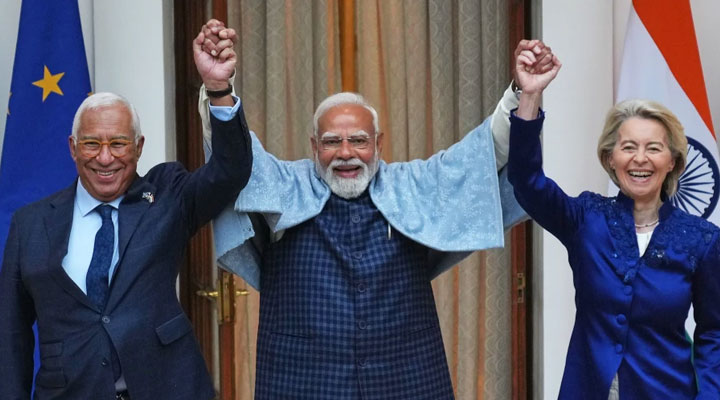
India has started 2026 with a rare burst of trade diplomacy. In a matter of weeks, New Delhi has wrapped up a major agreement with the European Union and finalized an interim arrangement with the United States. It is also lining up fresh talks with the Gulf Cooperation Council, a bloc that sits at the center of India’s energy links and a sizable portion of its external trade. The shift is unmistakable: India is moving away from the long, cautious phase in which negotiations dragged on for years and toward a more active approach that treats market access as a strategic priority.
But the harder question is what happens after the signing ceremonies. Trade agreements create options. They do not, by themselves, create export growth. The gap between “access on paper” and “results in shipments” is where India has often struggled, and where the success of this new wave of deals will be decided.
The real problem: businesses often don’t use the deal
A free trade agreement only delivers value if exporters actually claim the preferential terms. Historically, many Indian firms have not. Utilization has been low in part because the savings on tariffs can be wiped out by the practical cost of proving eligibility.
For smaller exporters, especially, the friction is familiar: complicated forms, uncertainty about what qualifies, fear of audits, and the risk that a paperwork error leads to penalties or delayed payments. When the compliance burden outweighs the tariff benefit, companies take the simplest route and pay the standard duty.
That makes a deal look strong in headlines but weak in outcomes.
Market access can turn into an import surge
Another pattern has repeatedly emerged in India’s trade experience: imports from partner countries rise quickly, while exports grow more slowly. This can happen for benign reasons, including faster access to cheaper inputs or consumer goods, but it becomes politically difficult when domestic producers feel squeezed, and trade deficits widen.
Some of India’s more recent agreements appear to have performed better than older ones, thanks to improvements in infrastructure and dispute-resolution processes. Still, the broader point stands: without the operational system to convert preferences into export volume, India risks repeating the same imbalance, opening up markets while failing to fully capture the upside.
Rules of origin are where deals succeed or fail
For many exporters, the hardest part of using an FTA is complying with “rules of origin.” These rules exist to prevent transshipment and light assembly, but in practice, they can be complex, expensive to document, and unevenly interpreted.
The burden can increase when firms must self-certify origin rather than rely on government-issued certificates. Self-certification speeds things up in theory, but it also pushes legal and financial risk onto the exporter. If a shipment is challenged later, the company may face back duties, fines, and reputational damage with buyers. In that environment, even firms that qualify may decide it is not worth claiming the preference at all.
So the issue is not whether tariff rates are lower. It is whether proving eligibility is simple, predictable, and safe.
India’s bigger hurdle is competitiveness, not treaties
Even if India’s exporters use the new deals more effectively, market share in the U.S. and EU will still be won on execution. Buyers care about reliability, lead times, logistics efficiency, and supply-chain depth as much as headline tariff rates.
This is where some Asian peers have built durable advantages. Places like Vietnam have become manufacturing magnets not just because they have agreements, but because they deliver speed and predictability: smoother customs clearance, tighter supplier networks, and fewer hidden transaction costs. Tariff parity alone does not shift sourcing decisions if a supply chain is slower, more complicated, or less dependable.
India has made progress in higher-end manufacturing, but it remains less competitive in several labor-intensive export categories, such as textiles, footwear, furniture, and other high-volume goods, where margins are thin, and delays are costly. Those categories are also critical for large-scale job creation, which is one reason the competitiveness question matters beyond trade metrics.
What has to change next
With major agreements now signed or underway, Delhi’s priority must shift from negotiation to execution. The practical reform agenda is not glamorous, but it is decisive:
- Reduce compliance friction so exporters can claim preferences without excessive paperwork, uncertainty, or audit fear.
- Standardize customs interpretation so rules are applied consistently across ports and regions.
- Lower logistics and transaction costs with faster clearance, better infrastructure, and fewer administrative bottlenecks.
- Make rules of origin workable through clearer guidance, simpler proof requirements where possible, and predictable enforcement.
If those pieces improve, the trade deals can translate into investment, jobs, and export growth that compounds over time. If they do not, 2026 will still look like a diplomatic breakthrough, but the economic payoff will be smaller than the scale of the announcements suggests.